Synopsis
Aliens in garish angelic form chose humankind as one of the races worthy of sharing an otherworldly paradise with them. Most people have already been “decanted.” Leo Salmon has not, but he watched as billions around him were transformed into blue gelatinous fluid in preparation for the long trip to Caldo. Leo and the remaining few un-decanted who have been unable to truly receive the “Angel’s Promise,” a requirement to initiate the transformation, are housed in Walnut Ridge, a pre-decantation facility, awaiting their fates.
The alien ships are leaving in a matter of days. If Leo and the other stragglers are unable to genuinely accept the alien offering in that time, while most of liquified humanity is transported to paradise, Leo and the rest of the abandoned will be left to build a new life on Earth-at least, that’s the plan right after they get some Taco Bell.
At face value, Walnut Ridge is an extraordinary account of our inability to transcend the mental trappings of our mortal frailty. However, beneath the distinctively unconventional story and its stunning imagery and absurd humor, you will find a unique allegory for the harrowing trials of mental illness, addiction, and recovery.

Book Information
- Genre: Literary, Science Fiction
- Themes and Topics: Alien invasions, first contact. mental illness, addiction, and recovery
- Release Date: March 20, 2024
- Pre-Sale: December 1, 2023
- Available: deadstarpress.com/product/walnutridge/
- Page count: 258
- ISBN: 978-1-955623-08-7
From the Author
Walnut Ridge, an outgrowth of an unfinished short story entitled “Bucket People,” was initially written between February 11 and April 27, 2019. Like many fictitious tales—despite how fantastical—the themes of this book are rooted firmly in reality. The pain, malaise, confusion, and dissatisfaction exhibited by these characters are familiar to many, as are the joy, friendship, love, and acceptance. It’s my belief that as humans, we are eligible for all the despair and all the contentment that human existence has to offer, granted that we are willing to adjust our expectations and attitudes to whatever that might mean…
As the world becomes smaller and smaller, I think there is a temptation to recede deeper and deeper within the self, and not without sound reason. It’s rough out there. Some of us are better equipped to handle it all than others. I, myself, have a relatively low tolerance for existence in general. For this reason, I try to count it as a blessing that the world has shrunk to the point where I can fairly easily reach outside of myself if I choose to do so. A lot of times, I do, and it works. Sometimes, I do, and it doesn’t feel like it works, but I get through the day. Sometimes it doesn’t work. But if I don’t try, then I’ve got no chance.
Though neither I nor the publishers of this book wish to imply representation for nor endorsement of any official organizations, there are resources for many of us, should we choose to make use of them. One such resource is the Suicide and Crisis Hotline, available by calling or texting 988 from your phone in the US. Sometimes it’s easier to barf your words out to a stranger than someone close to you.
AA.org is a great site to get some quick info about addiction and recovery if booze is part of your story. AA meetings are good places to learn about yourself and meet people with whom you might relate if you allow yourself to do so. Sometimes, they have free coffee, too. If you ever get really jammed up with static in your head, and nothing seems to be working, pick up this book and read it again. I’m sure it’s even more excruciatingly boring on the second read. It’ll put you right to sleep. When you wake up, some time will have passed, and you may have a chance to get a fresh perspective or make some positive choices! There’s no need to feel ashamed about getting help (as much help as it takes). Frankly, based on what I’ve seen, there’s very little to feel ashamed about in general these days. Huzzah!
I do hope you’ve enjoyed this book. I’m really not certain it’s any good, but it is a book. It has words and pages and a cover and shit. So, there’s that. You could use it to swat a fly or an angry wasp. I mostly wrote it in hopes of making sense of some of my own personal experiences over the past few years. It is my selfish desire that someone will read it and relate to it in ways that ultimately benefit them, whether they enjoy it or not. Many of us are looking for some form of connection or validation, egotistical fiction writers, perhaps more so than others. I sincerely thank you for reading.

Excerpt – Chapter 1
One of the Angels walked past the group meeting room. It was not, of course, a real angel in biblical terms. It was a visual approximation of an angel, and that was what they liked to be called, Angels. Leo Salmon only saw it walk by because he was not paying much attention to what was going on in the group meeting room. He rarely did. Sharing sessions seemed senseless and repetitive to him most of the time nowadays. He tried to give them a shot, but man, could they be boring.
In addition to the woman running the meeting, the tech, all the lodgers still residing at the facility were currently in the group meeting room. Their numbers amounted to nine now. When Leo first entered the facility, it was at full capacity with those in need of reprogramming. The mood at that time was light and airy and full of hope. The facility was a necessary stop on the way to the utopia the Angels were offering. Now, it seemed to Leo, all the glamour had been sapped from the atmosphere. That was more or less okay with him.
“Have you been putting effort into your homework?” asked Miranda, the tech running the meeting. She was a human, not an Angel, in her late thirties. She had likely been chosen for the job as much for her knowledge and background in psychology as for her appearance and warm demeanor. Most lodgers tended to trust her quickly and deeply despite knowing virtually nothing about her. Her question was addressed to George, a man who had been living in the facility almost as long as Leo.
“I always do my ‘homework,’” he said, harassed. “Though if it’s homework, I’d like the opportunity to actually work on it at my home.”
Miranda sighed. This was an old and often retreaded subject with long-term lodgers who came through the facility. “As you well know, you are welcome to leave and return to your homes at any time.”
“Right,” George scoffed. “I know. I can walk out the front door and drive myself right back to my house. I can buy a hundred pounds of steak at the supermarket that’s closed down and have a great big cookout with all my friends who have abandoned their houses to board the cross-ships.” He paused before adding, “That is, if I can find a gas station that’s still running between Vermont and New Jersey. If not, I might just break down and starve to death on the side of the road. Of course, then I’d be a ghost. I guess that wouldn’t be too bad. They don’t seem to give a shit about anything anyway.” It was an insensitive thing to say, given that there were three ghosts in the meeting.
The television was on but muted in the corner of the room. Playing was a rerun of a late-night talk show from sometime in the past year or so. There were only about three stations still broadcasting anymore. They were all computer-run and played old programming. The screen showed a man in a gray suit sitting at a desk, addressing the skeletal, humanoid robot who sat on a nearby couch. The host spoke with a grin and then awaited responses from the robot, which hardly even moved and had only a speaker for a mouth. Clipped to the barrel-like torso of the robot was a nametag reading “Chris.” This was common practice since most of the robot shells were identical and each typically contained dozens of deceased and decanted souls. Continue Reading
About the Author

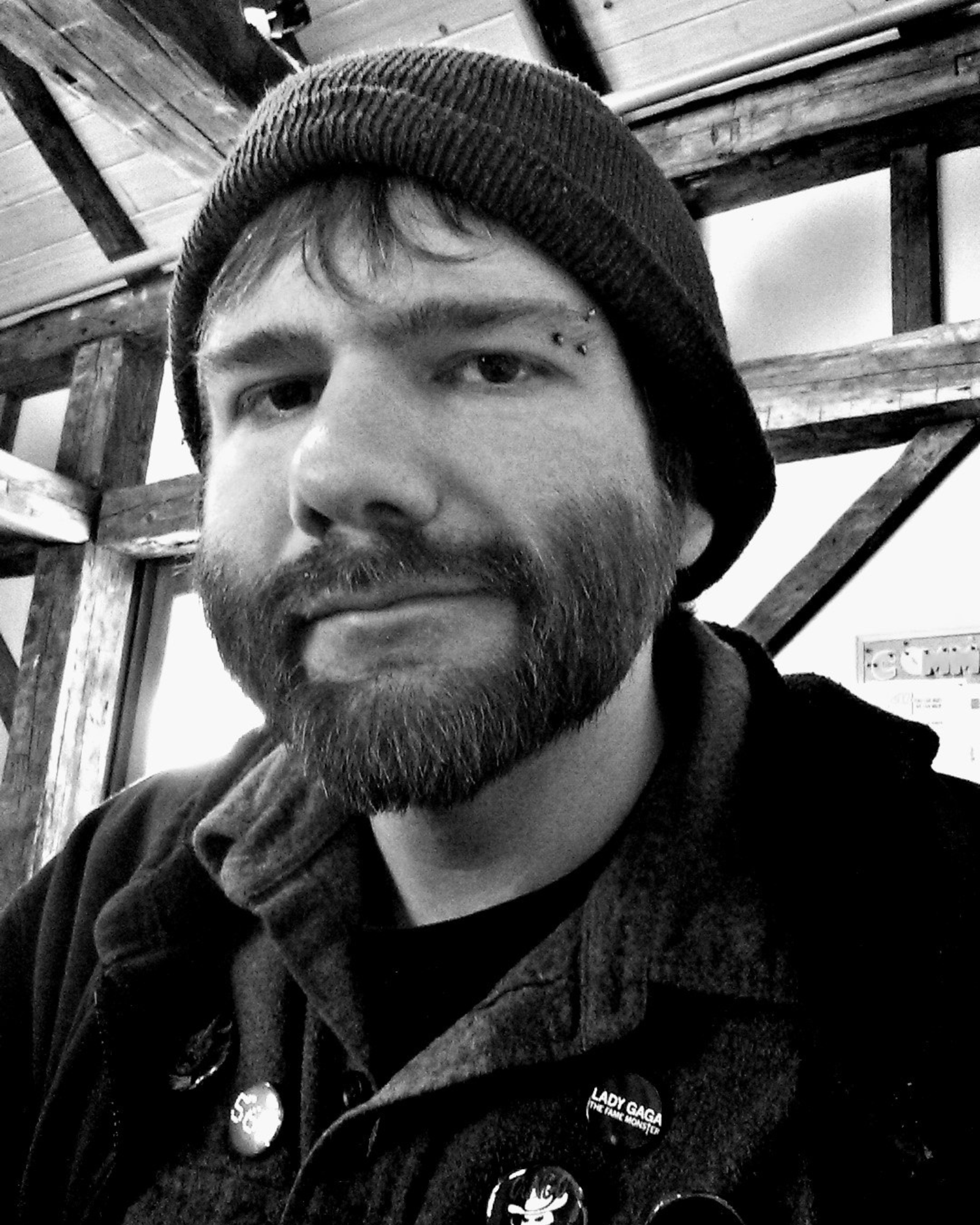
Dan Scamell (Daniel Vincent Scamell) is a writer of weird and speculative fiction that takes place in a slightly less pleasant version of the world in which we live. He is the co-author of the novella Stuck Together With You, and his short fiction has appeared in the Dead Star Press Anthology From the Dead, OOZE: Little Bursts of Body Horror, Coffin Bell Journal, and The Molotov Cocktail. Dan likes cats.
He currently lives in Pennsylvania, USA, with his robotic creation/pal Winston, where, in addition to writing, he also creates artwork, plays drums, and watches too much professional wrestling.
Dan’s works are available at DeadStarPress.com, DVSfiction.com, and Amazon.com.
Q & A with Dan Scamell
Please share a bit about your background and what inspired you to become a writer.
I was a bit of a late bloomer. I’ve always been creative, but aside from a story I started and never finished in second grade called Super Troll, I didn’t do too much writing until I was almost thirty. I started writing “creepypasta,” mostly in the genre of creepy video games. Every journey has to start somewhere. As a kid, I would write and draw little comics, and later, I wrote lyrics for bands I was in, but I never really considered narrative fiction until I started reading Vonnegut. I read Slaughterhouse 5 in my twenties, and it opened my eyes to the possibilities of fiction writing. It came across so open and loose, yet impactful. The fact that you could write about something by not writing about it really hit with me. That you could craft a story that works both on a narrative level and a thematic level and that it could present itself in a way that didn’t speak down or make a reader feel stupid was something that really resonated with me.
Can you describe your writing process? Do you have any specific rituals or routines that help you stay focused?
Aside from trying not to force myself to work if I’m struggling too much and, conversely, forcing myself to work if I notice I’m becoming too much of a miserable bastard, I don’t have much of a set routine. As far as process, it always seems to be different.
I went through a phase where I was waking up early and going to a coffee shop for a few hours. I was very productive at that time with short stories and some novel work. I don’t have any solid roots down anywhere right now, so I tend to try to be able to work loose and scrappy when I can. That said, the last longer-form piece I wrote was during National Novel Writing Month in 2022, and I built myself a fold-down desk in my closet and spent hours and hours in there for a couple of weeks. So, I guess the short answer is “no.”
How do you go about developing your characters, and are they inspired by real people or experiences?
A lot of the characters I write tend to be facets of my own personality that I attempt to combine with people I know or have met before. When writing, I do my best to let them do what they want without interfering too much. Usually, by the time I finish a piece, they’ve changed and grown, and I try to go back through and make them more cohesive if I can. I sometimes like to have a character say something that I’ve heard someone I know say, and I build from there.
What was the initial spark or idea that led to the creation of Walnut Ridge?
The idea sort of stems from an alternate take on the cliche of pod people. What if it really was better to be cloned or brainwashed and never have to think or worry about anything again? I know that my mind tends to race a lot and ruminate over things that don’t really matter, so there are times when a lobotomy doesn’t sound too bad. That said, I don’t know if there are any catch-all solutions for the masses of humanity. Some things are fine for some people, and other things work for others. If I decided to become a pod person on a bad day, I’d probably regret it later when I was feeling better. Maybe not. Who knows!
The concept was also a reaction to the amount of solution-oriented thinking that seems to pervade society and media in modern times. Medication, fad diets, downsizing, consumerism—I think a lot of times we’re very oriented to get to the solution to our perceived problems as quickly and painlessly as possible. The concept of decantation, of having your body and mind reduced to a jar of goop, seemed natural. It’s a way to cure all physical and mental health issues, simplify your life, and, generally, be happier. That was the spark that got me to start “Bucket People,” an unfinished short story that eventually became Walnut Ridge.
Many readers enjoy discovering the themes and messages woven into a story. What central themes or messages do you hope readers will take away from Walnut Ridge?
Author intent is only one minor facet of interpretation, so I’m always interested to hear what people take from what I write. It helps me better understand myself. I think the main takeaway I’d like any reader to have would be the importance of attempting to retain an open mind. I find myself writing characters on a scale on which the more certain they are about things, the less correct they end up being about said things.
Every writing journey has its challenges and rewards. Can you share some of the most significant challenges you faced while writing this book and the most rewarding aspects of the process?
Initially, Walnut Ridge was part of a purging of things that had been swirling around in my brain for years. The actual writing process went very quickly, and I was able to keep up a pace without much trouble. I recall one challenge being striking a balance between keeping things vague and open to a reader without being cryptic. I wanted the book to work on different levels independently, and I was never sure if I was being too overt or burying the lead. The main challenges have been editing, revising and rewriting.
I think the most rewarding part was just getting all this stuff out. The themes and questions that led me to write this book still remain in my mind, but they’re compartmentalized in a way that frees up some space in my failing hard drive.
Do you have a favorite scene or character in the book? If so, what makes it special to you?
Alphonse, the human who’s been decanted into a jar of blue ooze and connected to a computer, was a lot of fun to write. I enjoyed writing a character who is fundamentally different from his peers, physically and emotionally, yet is still a human in many of the subtle ways that tie us to the human condition.
There’s a scene in the story in which the characters are driving through the uninhabited world to break into a Taco Bell and cook themselves a meal, and one character, Brock, begins singing an old funk song. Alphonse recognizes the song and chimes in with his monotone, computer-generated voice. The two alternate “singing” the lyrics. It was a fun scene and felt inconsequential in the best and most natural of ways.
How did the genre of science fiction and mental health influence each other in Walnut Ridge?
I think reading Vonnegut really pushed me into merging the two. I desperately wanted to write about my personal experiences and feelings but didn’t know how to do so in an accessible way or without pretension. Weird SF and contemporary fantasy are great because you can warp our own reality into one that’s recognizable but fantastical enough to distract a reader and keep from being overbearing with themes.
It felt like a natural fit since weird science fiction asks a reader to exist in a world that we can identify with on many levels but also to go along with the shit that makes no sense. It’s honestly how I feel most days. I wake up, and there’s air and a sun and gravity and stuff, but the rest, obligation, emotion, interaction, it’s sort of transient and nonsensical.
Balancing personal experiences with imagination is crucial. How did you manage this in the book?
I’m horrifically insecure, so I mainly try to write about things I’ve experienced personally or learn from a trusted friend. Otherwise, I’ll talk myself out of writing about anything at all. I try my hardest to inject my stories with actual events that have happened to me, even if I don’t fully understand them. I think that helps bridge the chasm between reality and the fantastic.
As I’ve alluded to, reality doesn’t make a lot of sense to me, so I think that helps as well. Most days, I feel like I’d be as unfazed by gigantic, fleshy abominations crawling through the streets as I am by the banal advertisements I see on TV. I tend to observe things and consider possible outcomes so I can prepare myself to act, which is quite draining and makes it tough to interact effectively and honestly, but it seems to help with creativity. So, there’s that.
Walnut Ridge explores the concept of the “Angel’s Promise” as a requirement for transformation. How did you develop and convey this otherworldly element in the context of mental health and addiction?
Without saying too much, the Promise was my take on a very integral part of certain addiction recovery programs. It basically comes down to developing a personal concept of faith—choosing to turn oneself over to it. Breaking down one’s walls and accepting help from whatever and whomever is there to help. Usually, stuff like that is way less complicated than my mind wants to make it. One of the criticisms I got while writing Walnut Ridge was the vagueness of the Promise, but in a sense, that’s sort of the point. (This is what writers say when they’ve failed to effectively convey a concept.)
The choice between accepting the alien offering and building a new life on Earth serves as a pivotal metaphor in the story. How did you approach crafting this metaphor and its relevance to the challenges of recovery within societal norms?
Something I come back to a lot is, “What would you do if you weren’t afraid?” I try to work that sentiment into my life when I can, but I find it interesting to look at it from other perspectives as well. It’s easy to say, “If I wasn’t afraid of failing, I would put all my efforts into achieving my goals.” But what about the other side? What would I do if I wasn’t afraid of not achieving my goals? I guess that would be either contentment or resignation. Maybe those aren’t as different as I think they are, and maybe we can put effort into making that choice. I think that decision was sort of an underlying thread to the story. A great deal of living day to day comes down to deciding to be okay in situations that don’t feel like they’re okay. I wanted to create a world where the fear has been removed, and what remains is faith. But sometimes, connecting to that faith is difficult for reasons we aren’t even aware of.
As an author, how do you see the role of science fiction in addressing and exploring complex issues such as mental health and addiction?
Genre fiction is great for tackling those sorts of things. Sci-fi, speculative fiction, fantasy, it all makes for a perfect backdrop to talk about serious stuff. I don’t think there’s anything wrong with hard sci-fi—rockets and aliens and political intrigue and whatever. But I think creating a slightly altered version of our world is a great tool for easing into talking about relatable issues without coming across too straightforward or preachy. It’s a good way to disarm a reader and hopefully make them more open to considering the similarities between their life and their world since the differences presented are so pronounced.
We’ve come a long way as a species in terms of noticeable advancement. We’re living in the future. We have been for a while now. And yet people are still fucked up. At a core level, I think most of us are trying to fill a void in ourselves. Some do it in healthier ways than others, but a lot of us are still longing for something—either searching for it or actively distracting ourselves from the search. I think that’s something ingrained in us at some level, and SF is a good venue to explore that since it highlights how, regardless of our achievements or downfalls—regardless of our level of comfort or distress, it’s natural to long for something. Whether you’re in utopia, on a dying world, or out in a spaceship.
The humor in the book seems to be an integral part of the storytelling. How did you use humor to enhance the narrative and convey the complexities of mental health and recovery?
Humor and levity are incredibly important to me in life and in writing. I find it difficult to take things seriously, sometimes to a fault. Gallows humor can be especially effective when things have really gone to shit. When dealing with issues that feel hopeless, sometimes the physical change that comes with a good chuckle can help shift perspective from a dangerous mindset to a more manageable one. Not always, but it’s usually worth it. Some of the best jokes come out when you gather a few failed suicides in one room.
I often use humor in my writing when I’m feeling especially cowardly. It can be difficult to get down and dirty. When I need to get really honest and vulnerable, I tend to favor cracking jokes or adding silly shit to a narrative so I don’t get so insecure about exposing myself. Don’t quote that out of context, please.
The imagery in Walnut Ridge is stunning. How did you approach crafting vivid and memorable visuals in the narrative, and what significance do these images hold in conveying the underlying themes of the book?
(This is kind of a longer one)
A lot of what’s in the book is just sort of what I enjoy and find amusing. I tackle some serious stuff in this book, but there’s a great deal of humor and gags as well. I’m a big fan of older technology, so I threw a bunch of that into the story. I thought it would be amusing for an alien race to have technology beyond our comprehension but also still use wildly outdated things like CRT monitors, vacuum tubes, punch cards, magnetic tape, all that crap. It was good enough for aliens back in 1950s movies, so why not now?
The appearance of the aliens, the Angels, lends itself to speculation about religious themes, but it was a decision I made almost entirely based around a visual gag rather than trying to make a commentary on organized religion, though some parallels can certainly be made. I thought it would be amusing for the Angels to appear in a form they judged to be “Good enough” to convince a race that had advanced more than they’d anticipated. To be walking around in these giant, uncanny humanoid vessels kind of speaks to their hubris as a race.
The purple sky from the gas the Angels used to put humanity at ease during their arrival was meant to be a constant reminder that things are not as they used to be and also an indication that the Angels may not have planned things out as well as they ought to have. Also, purple is cool.
Alphonse was just based on how a human who was turned into goop would need to be modified for a return life among un-decanted humans. A slapdash setup with a mini-computer and speaker. The vessels used to house ghosts felt like something you would see in a B sci-fi movie.
The Cindervale setting is based on the greater Scranton, PA area and will probably feel familiar to friends of mine if I’ve described it well enough. I’m most comfortable writing areas like that–depressed, former mining towns surrounded by forests and farmlands. I’ve used Cindervale in a few stories now, and I’m sure it will pop up again.
What’s next for you as an author? Can you provide any insights into your upcoming projects or the direction your writing may take in the future?
I try to watch for themed short story calls to keep me moving. I tend to do genre stuff, horror and weird fiction. I’ve got a few longer-form ideas I’m hoping to work on. A couple of drafts have been started. I’ve got some novel manuscripts I’m shopping around, one is another literary speculative fiction story kind of similar to Walnut Ridge but much heavier, and I’m not sure it’s any fucking good, but I adore a lot of it. There’s another shorter novel (the one I wrote in my closet) that I’d really like to get out. It’s weird and sort of surreal and, again, deals with themes of mental illness and addiction.